Annotation#
Annotations play a crucial role in machine learning projects. If you’re unhappy with your model’s performance, annotating new samples is the best first step to improving it.
Note: DeepForest >1.4.0 supports annotations in COCO and Pascal VOC format.
The machine learning annotation space is moving very quickly, and there are dozens of annotation tools and formats. DeepForest supports the following formats using the read_file function:
CSV (
.csv)Shapefile (
.shp)GeoPackage (
.gpkg)COCO (
.json)Pascal VOC (
.xml)
An incomplete list of annotation tools DeepForest users have reported success with:
QGIS
Label Studio
CVAT
Labelme
Agentic
AWS Ground Truth
LabelBox
Roboflow
and many more
We intentionally do not create our own annotation tools, but rather focus on supporting community-created tools. Look for exports in .xml, .json, or .csv formats, which are all common in the above tools.
How do we annotate images?#
For quick annotations of a few images, we use QGIS either as projected or unprojected data. You can create a shapefile for each image.
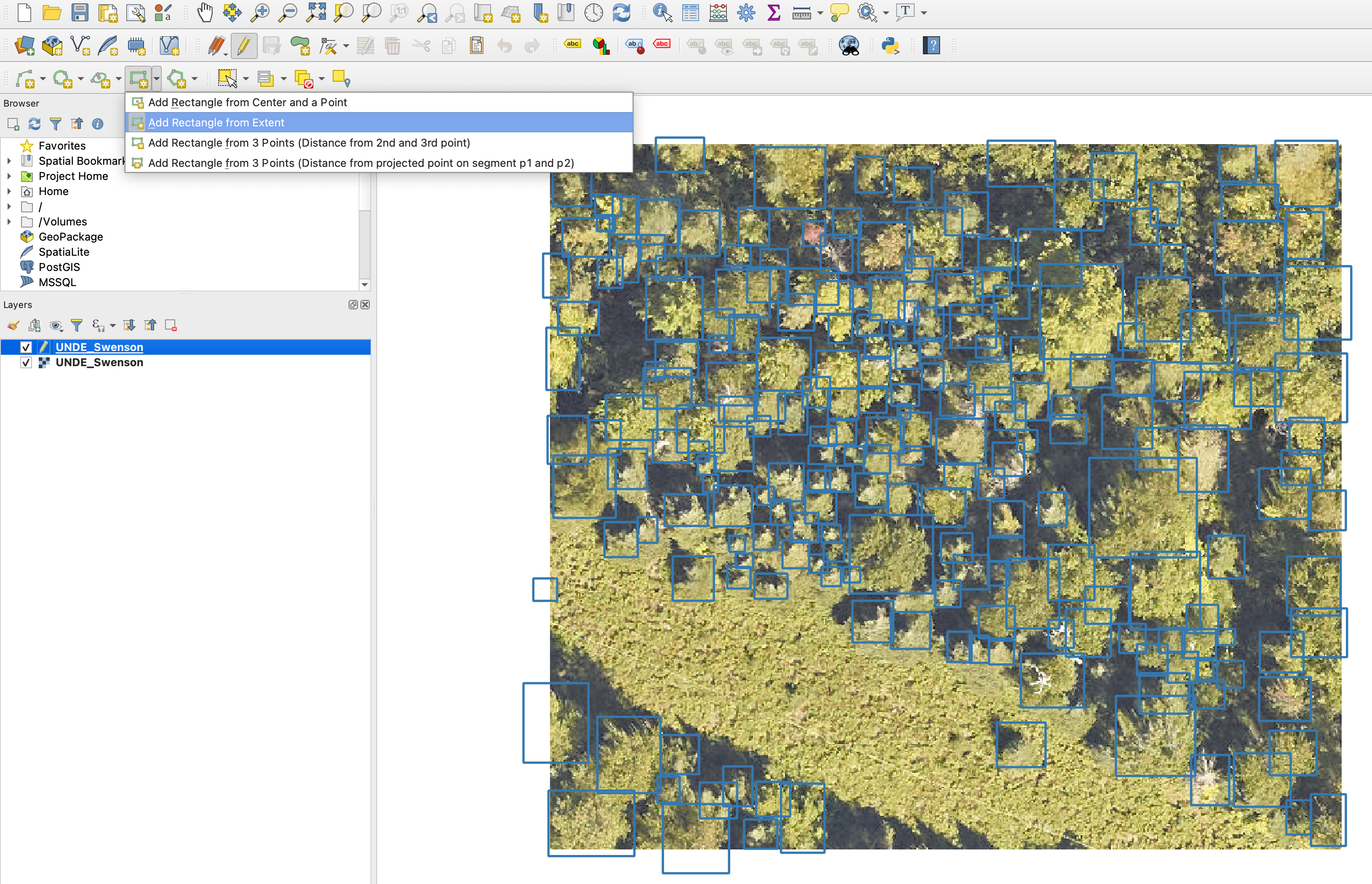
QGIS annotation example.
Label Studio#
For long-term projects, we recommend using Label Studio as an annotation platform. It offers many useful features and is easy to set up.
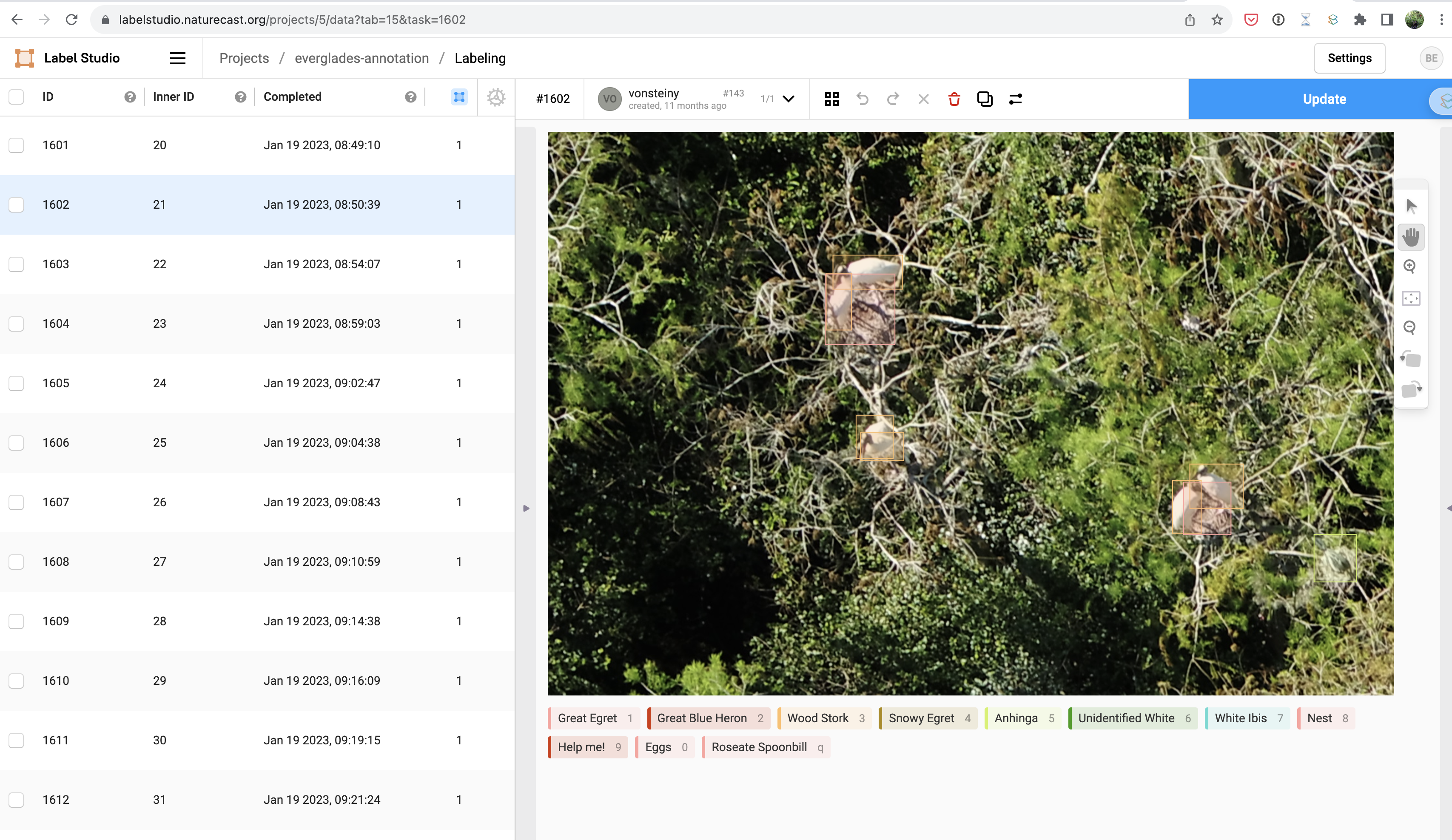
Label Studio annotation platform.
Exporting Annotations for DeepForest#
To ensure compatibility with DeepForest, export your annotations from Label Studio in Pascal VOC XML format. This format is widely used for object detection tasks and can be directly read by DeepForest’s read_pascal_voc function.
Steps to Export in Pascal VOC Format#
Navigate to your project in Label Studio.
Click on the Export button.
Select Pascal VOC XML as the export format.
Save the exported XML file.
For more details on reading Pascal VOC annotations in DeepForest, see: reading-xml-annotations.
Do I Need to Annotate All Objects in My Image?#
Yes! Object detection models use non-annotated areas of an image as negative data. While annotating all objects in an image can be challenging, missing annotations will cause the model to ignore objects that should be treated as positive samples, leading to poor performance.
How Can I Speed Up Annotation?#
Select Important Images: Duplicate backgrounds or objects contribute little to model generalization. Focus on gathering a wide variety of object appearances.
Avoid Over-splitting Labels: Often, using a superclass for detection followed by a separate model for classification is more effective. See the
CropModelfor an example.Balance Accuracy and Practicality: Depending on the goal (e.g., object counting or detection), keypoints can sometimes be used instead of precise boxes to simplify the process.
Quick Video on Annotating Images#
Here is a video demonstrating a simple way to annotate images:
Converting Shapefile Annotations to DataFrame#
You can convert shapefile points into bounding box annotations using the following code:
df = shapefile_to_annotations(
    shapefile="annotations.shp",
    rgb="image_path",
    convert_to_boxes=True,
    buffer_size=0.15
)
Cutting Large Tiles into Pieces#
Annotating large airborne imagery can be challenging. DeepForest has a utility to crop images into smaller, more manageable chunks.
raster = get_data("2019_YELL_2_528000_4978000_image_crop2.png")
output_crops = preprocess.split_raster(
    path_to_raster=raster,
    annotations_file=None,
    save_dir=tmpdir,
    patch_size=500,
    patch_overlap=0
)
Starting Annotations from Pre-labeled Imagery#
You can speed up new annotations by starting with model predictions. Below is an example of predicting detections and saving them as shapefiles, which can then be edited in a tool like QGIS.
import os
from glob import glob

import rasterio as rio

from deepforest import main
from deepforest.utilities import image_to_geo_coordinates
from deepforest.visualize import plot_results

PATH_TO_DIR = "/path/to/directory"
files = glob(f"{PATH_TO_DIR}/*.JPG")
m = main.deepforest(config_args={"label_dict": {"Bird": 0}, "num_classes": 1})
m.load_model(model_name="weecology/deepforest-bird", revision="main")

for path in files:
    boxes = m.predict_image(path=path)
    rio_src = rio.open(path)
    image = rio_src.read()

    if boxes is None:
        continue

    plot_results(results=boxes)

    basename = os.path.splitext(os.path.basename(path))[0]
    shp = image_to_geo_coordinates(boxes, root_dir=PATH_TO_DIR, projected=False)
    shp.to_file(f"{PATH_TO_DIR}/{basename}.shp")
Reading XML Annotations in Pascal VOC Format#
DeepForest can read annotations in Pascal VOC format, a widely-used dataset format for visual object detection. The read_pascal_voc function reads XML annotations and converts them into a format suitable for use with models like RetinaNet.
Example:#
from deepforest import get_data
from deepforest.utilities import read_pascal_voc

xml_path = get_data("OSBS_029.xml")
df = read_pascal_voc(xml_path)
print(df)
This prints:
    image_path  xmin  ymin  xmax  ymax  label
0   OSBS_029.tif   203    67   227    90   Tree
1   OSBS_029.tif   256    99   288   140   Tree
2   OSBS_029.tif   166   253   225   304   Tree
3   OSBS_029.tif   365     2   400    27   Tree
...
Fast Iterations for Annotation Success#
Avoid collecting all annotations before model testing. Start with a small number of annotations and let the model highlight which images are most needed. Fast iterations lead to quicker model improvement. For an example in wildlife sensing, see Kellenberger et al., 2019.
Please Make Your Annotations Open-Source!#
DeepForest’s models are not perfect. Please consider sharing your annotations with the community to make the models stronger. You can post your annotations on Zenodo or open an issue to share your data with the maintainers.