Package overview#
What is DeepForest?#
DeepForest is a Python package for training and predicting ecological objects in airborne imagery. DeepForest comes with prebuilt models for immediate use and fine-tuning by annotating and training custom models on your own data. DeepForest models can also be extended to classification (e.g., species) based on new data. DeepForest is designed for:
Applied researchers with limited machine learning experience
Applications with limited data that can be supported by prebuilt models
Scientists looking for an easy-to-use baseline to compare methods against
DeepForest uses deep learning object detection networks to predict the location of ecological objects in airborne imagery. The design of DeepForest is intended to be simple, modular, and reproducible.
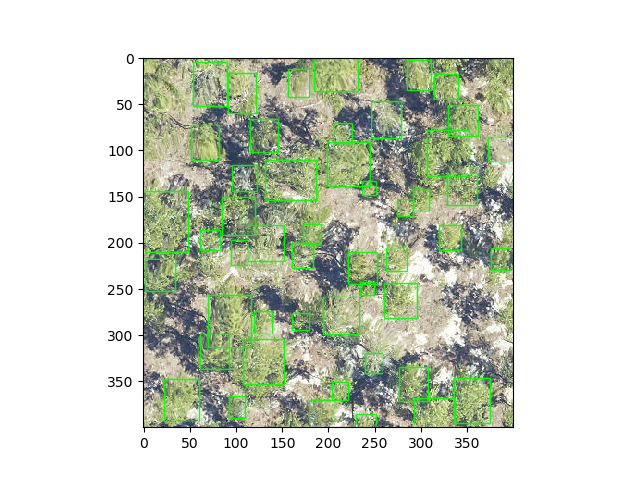
For more about the motivation behind DeepForest, see some recent talks we have given on computer vision for ecology and practical applications to machine learning in environmental monitoring.
DeepForest Walkthroughs and Presentations#
Ecological Society of America Statistical Seminar#
This video provides an overview of fine-tuning a prebuilt model. The accompanying notebook is also available (Bird FineTuning.ipynb).
Practical Intro to Computer Vision in Ecology Research#
Where can I get help, learn from others, and report bugs?#
Given the enormous array of taxa, background, and image acquisition environments, it is unlikely that your image will be perfectly predicted by a prebuilt model. Check out the ‘training’, ‘annotation’, and ‘predicting’ sections of the documentation for more information on how to improve predictions using your own data.
Get suggestions on how to improve a model by using the discussion board. Please be aware that only feature requests or bug reports should be posted on the issues page. The most helpful thing you can do is leave feedback on the DeepForest issue page. No feature, issue, or positive affirmation is too small. Please do it now!
Why DeepForest?#
Observing the abundance and distribution of individual organisms is one of the foundations of ecology. Connecting broad-scale changes in organismal ecology, such as those associated with climate change, shifts in land use, and invasive species, requires fine-grained data on individuals at wide spatial and temporal extents.
To capture these data, ecologists are turning to airborne data collection from uncrewed aerial vehicles, piloted aircraft, and earth-facing satellites. Computer vision, a type of image-based artificial intelligence, has become a reliable tool for converting images into ecological information by detecting and classifying ecological objects within airborne imagery.
There have been many studies demonstrating that, with sufficient labeling, computer vision can yield near-human-level performance for ecological analysis. However, almost all of these studies rely on isolated computer vision models that require extensive technical expertise and human data labeling. In addition, the speed of innovation in computer vision makes it difficult for even experts to keep up with new innovations.
To address these challenges, the next phase of ecological computer vision needs to reduce the technical barriers and move towards general models that can be applied across space, time, and taxa.
DeepForest aims to be simple, customizable, and modular. DeepForest makes an effort to keep unnecessary complexity hidden from the ordinary user by developing straightforward functions like predict_tile. The majority of machine learning projects actually fail due to poor data and project management, not clever models. DeepForest makes an effort to generate straightforward defaults, utilize already-existing labeling tools and interfaces, and minimize the effect of learning new APIs and code.
How can I contribute?#
DeepForest is an open-source Python project that depends on user contributions. Users can help by:
Making recommendations to the API and workflow. Please open an issue for anything that could help reduce friction and improve the user experience.
Leading implementations of new features. Check out the ‘good first issue’ tag on the repo and get in touch with the maintainers to tell us about your skills.
Data contributions! The DeepForest backbone models are not perfect. Please consider posting any annotations you make on Zenodo, or sharing them with DeepForest maintainers. Open an issue and tell us about the RGB data and annotations. For example, we are collecting tree annotations to create an open-source benchmark. Please consider sharing data to make the models stronger and benefit you and other users.
Citation#
Most usage of DeepForest should cite two papers:
The first is the DeepForest paper, which describes the Python package:
Note
Weinstein, B.G., Marconi, S., Aubry‐Kientz, M., Vincent, G., Senyondo, H. and White, E.P., 2020. DeepForest: A Python package for RGB deep learning tree crown delineation. Methods in Ecology and Evolution, 11(12), pp.1743-1751. https://doi.org/10.1111/2041-210X.13472
The second is the paper describing the particular model. See Prebuilt Setup for citations for each model.
License#
MIT License
Copyright © 2019, Ben Weinstein
Permission is hereby granted, free of charge, to any person obtaining a copy of this software and associated documentation files (the “Software”), to deal in the Software without restriction, including without limitation the rights to use, copy, modify, merge, publish, distribute, sublicense, and/or sell copies of the Software, and to permit persons to whom the Software is furnished to do so, subject to the following conditions:
The above copyright notice and this permission notice shall be included in all copies or substantial portions of the Software.
THE SOFTWARE IS PROVIDED “AS IS”, WITHOUT WARRANTY OF ANY KIND, EXPRESS OR IMPLIED, INCLUDING BUT NOT LIMITED TO THE WARRANTIES OF MERCHANTABILITY, FITNESS FOR A PARTICULAR PURPOSE AND NONINFRINGEMENT. IN NO EVENT SHALL THE AUTHORS OR COPYRIGHT HOLDERS BE LIABLE FOR ANY CLAIM, DAMAGES OR OTHER LIABILITY, WHETHER IN AN ACTION OF CONTRACT, TORT OR OTHERWISE, ARISING FROM, OUT OF OR IN CONNECTION WITH THE SOFTWARE OR THE USE OR OTHER DEALINGS IN THE SOFTWARE.